Friday, 11 April 2014
Reflective Post
Graffiti in Urban areas are seen throughout the country. J. Jones, M. Moraldo and A. Dookeran all shared some aspect of art in their blogs which showcased the culture of Trinidad and Tobago.

Graffiti and the Environment
 |
“Graffiti is an impulse
to get recognized”
― Mint&Serf
|

Not only does graffiti seek to inspire through the environment it also has its negative impacts. Traditional paint based graffiti release toxic chemicals into the environment.
Urban Politics
 |
“Art is an evolutionary
act. The shape of art and its role in society is constantly changing. At no
point is art static. There are no rules.”
― Raymond Salvatore
Harmon, BOMB: A Manifesto of Art Terrorism
Photo taken along St James, P.O.S
|
Looking for graffiti throughout
P.O.S many political complaints where plastered on walls, but due to the crime
rate in the areas these writings were on it was a too risky to go in. However,
in a political sense, many marginalized
communities surrounding the CBD in Trinidad often use public walls to use writing on walls as a form of protest.
How Much For Da Graffiti?
 |
| “Speak softly, but carry a big can of paint.” ― Banksy, Wall and Piece. |
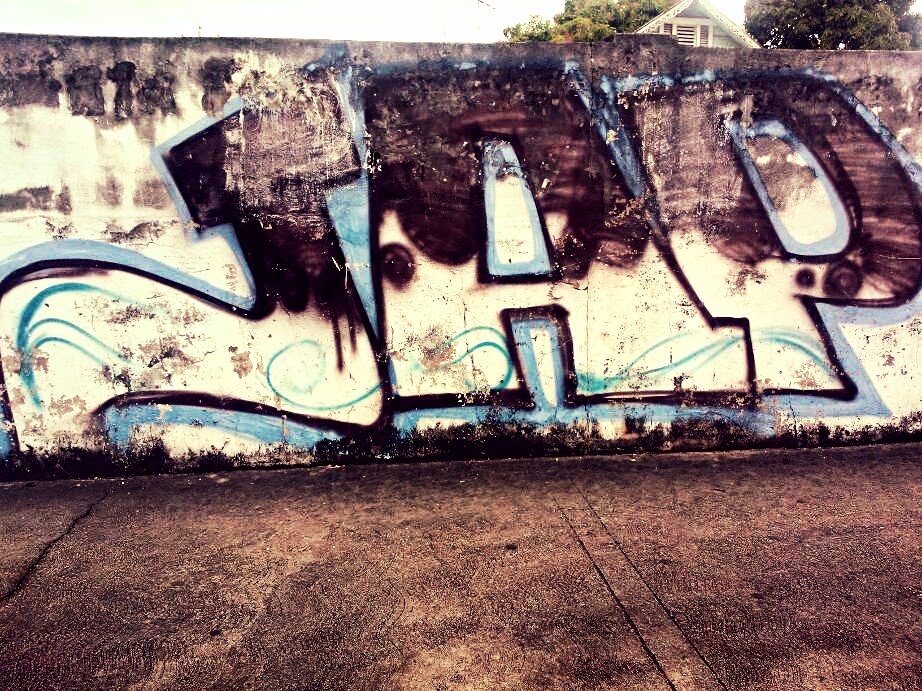
The photo above was taken along St. James Street, P.O.S it is basically a tag done by "kraze". Throughout the city there are multiple tags done by "Kraze". However, what may just seem like the tagging of an empty space to claim an identity or to gain recognition for others does have serious effects. There is a perception that graffiti is associated with blight and alarms patrons of the city of gang activity (Weisel, 2002). It gives the impression that the city is spiraling downward because which can cause many businesses to loose appeal to consumers.
In terms of safety, because of the presence of graffiti in an area many patrons may feel unsafe in that area because if vandalism is tolerated more serious crimes may be unchallenged. Shockingly, in Trinidad the owner or occupant of a property that graffiti is found one may be required to clean it up at their own cost! (Judging from all the graffiti that persists throughout P.O.S it leaves one to wonder if this law is enforced.
Urban City Home of Graffiti
 |
| “Everyone has to scratch on walls somewhere or they go crazy” ― Michael Ondaatje, In the Skin of a Lion. Photo taken: Wrightson Road, P.O.S
Do graffitists live in the city? Do they just choose to vandalize city? If so, why?
The image above was taken along Wrightson road, the entrance of company. This picture was taken from a moving vehicle hence the words couldn't be made out properly.
In terms of why graffiti artists choose to frequently vandalize the urban area rather than a rural area this may be due to the importance of urban areas. Many urban areas if not all, are the host of MNC's, TNC's, government agencies and other local businesses. In Port of Spain, I would imagine graffiti being done there because that is where the "image" or "opinions" they're trying to get accross would
get the most exposure. For instance, the Parliament of Trinidad and Tobago is in Port of Spain thus many of our countries top figures will see the graffiti plastered on walls and this is the kind of recognition that most individuals seek when trying to portrayal a social concern.
Whereas, in some rural areas graffiti seems to be virtually non existent because these areas are usually not the center of attention. Thus, it can be said that one of the reasons for graffiti being common in the urban landscape is due to the importance of the urban area itself.
It is important to note that contemporary graffiti's connection to post-modernism in urban areas certainly began as a response to the flaws of modernism but it was able to establish itself as an independent discipline that understood how to manage and employ meaning within a cultural context.
|

Show Me Your Graffiti and I'll Tell You Who You Are.
 |
| “Some people become cops because they want to make the world a better place. Some people become vandals because they want to make the world a better looking place.” -Banksy |

Graffiti For Yuh Money
 |
| “Graffiti is one of the few tools you have if you have almost nothing. And even if you don't come up with a picture to cure world poverty you can make someone smile while they're having a piss.” - Banksy |
The picture above illustrates how graffiti style art has become a tool of advertising. Graffiti has a captive audience, a condition it shares with advertising (Dovey et al.,2012). In my opinion, this style shown above has obviously emerged from real graffiti found all throughout P.O.S. It makes sense to use graffiti style paintings on buildings as not only is it quite unique and eye catching, it also attracts a younger crowd to the place.

Through the emergence of graffiti as a form of advertising this trend has trickled down to Trinidad's advertising strategy. This is a direct indication of the impact that the global north and media has on the global south.
References:
- Kim, Dovey, Simon Wollan, and Ian Woodcock, 2012. "Placing Graffiti: Creating and Contesting Character in Inner-city Melbourne."
- Ley, D. and Cybriwsky, R., 1974. URBAN GRAFFITI AS TERRITORIAL MARKERS*. Annals of the Association of American Geographers, 64(4), pp.491--505.
Related articles:
- http://www.reversegraffiti.co.uk/reverse-graffiti-advertising.html
Monday, 7 April 2014
Hey public space may i leave my mark on you?
 |
| ‘In a city that belongs to no-one, people are constantly seeking to leave a trace of themselves…’ (Sennett 1990:205) Photo taken along St James Street P.O.S |
In cities where space is a privilege, graffiti artists' view on space is quite different than the typical citizen. They view space in an absolute sense where it is free until it becomes occupied. These "underutilized" spaces are then used by the graffiti artists to leave their mark on to be identified by their peers and showcase their skills to the rest of the graffiti artists (Bandaranaike, 2001).
In today's world where graffiti has evolved from gang graffiti or tagger graffiti to artistic graffiti, it is viewed as a spatial phenomena that allows for artists to defend a space for themselves in an urban landscape (Gunes et al., 2006). Due to the positioning of graffiti on public and private property that near to public spaces, graffiti has become prominent in urban landscapes as they are seen all throughout the world in many different cities. As mentioned in previous blogs, graffiti work has also gained attention from many tourists, so it has become etched as apart of an urban landscape.
References:
- Gunes, Serkan and Yilmaz, Gulsen (2006) Understanding Graffiti in the Built Environment, 42nd ISoCaRP Congress 2006.
- Bandaranaike, S. 2001. Graffiti: A culture of aggression or assertion? The Character, Impact and Prevention of Crime in Regional Australia Conference, 2-3 August 2001.
Sunday, 6 April 2014
Tagger's Irony
 |
| "People say graffiti is ugly, irresponsible and childish... but that's only if it's done properly.” ― Banksy, Wall and Piece. Taken along Wrightson Road
Isn't this photo ironic, that taggers speak about people coming at thieves at night, when they themselves come at night to tag buildings, walls and other public spaces? I couldn't help but laugh at the irony of this.
In today's blog, I shall attempt to look at whether urban graffiti is simply street art or vandalism? The distinction between the two seems to be a little unclear. Vandalism and street art are often regarded as complete opposites, vandalism as destruction and street art as creation (Dovey, Wollan and Woodcock 2012,2). In some cities, such as Melbourne Australia, they are famous for their graffiti. The Lonely Planet travel guide listed Melbourne's inner city as one of the city's premier tourist attractions. Upon researching this city's graffiti I was stunned to see the amazing detailed pieces of graffiti plastered along streets. This brings me to my question, is this considered street art? Or vandalism? Or both maybe? Melbourne sure is gaining tourist attention for their graffiti filled streets which would contribute to their economy. However, officials have stated that graffiti is not the way they want Melbourne to be portrayed, which brings me to another question, if such graffiti is attracting positive attention why isn't it referred to as street art? Why isn't it embraced?
I can personally understand why graffiti may be looked at as vandalism when it's done to deface architectural sites and done to individual's private property, but when a truly amazing piece is done to an empty wall on the corner or back lot I can appreciate that and call it street art. It shows an unexpected side to urban culture that creates a renewal in interest in many areas.
References:
Kim, Dovey, Simon Wollan, and Ian Woodcock, 2012. "Placing Graffiti: Creating and Contesting Character in Inner-city Melbourne."
Dovey, Kim, Simon Wollan and Ian Woodcock. "Placing
Graffiti: Creating and Contesting Character in Inner-city Melbourne."
Journal of Urban Design vol 17, no. 1 (2012): 2.
Related articles:
|
Sunday, 23 March 2014
Placecheck

The international waterfront center was a project aimed at revitalizing the water front of Trinidad's and Tobago capital. The aim of this project is in cohesion with Brooks and Young article on the downtown revitalization of New Orleans from the period 1973-1993.
Upon walking through the entrance of the Hyatt Regency Hotel the mood is already set, cars entering and leaving the area, presence of armed policemen, well dressed businessmen and woman and the down to business staff. As i approached the waterfront I couldn't help but appreciate the incorporation of the natural environment into this area. The ambiance, openness of space and the incorporation of Trinidad's history through the enchanting wall that showcased our Olympic achievements. I couldn't help but wonder why there wasn't a presence of patrols along the waterfront itself. Clearing such an area would be in need of protection from vandalism. This would have been one of the things that i would have cared to see more of.
Speaking about things I would like to see a change in, there definitely needs to be an incorporation of signs along the waterfront. Throughout the area there were maybe maximum two signs that I saw that urged parents to be vigilant in the supervision of their kids. In addition, when you compare this area to lets say an area such as the Brian Lara Promenade or Woodford Square there is clearly a distinction in the amount of people and the various classes of people engaging in activities in the respective areas. Maybe it wouldn't be such a bad idea to encourage a wide range of individuals to come to the waterfront and this can be achieved by making this area seem more user friendly.
Placecheck: Belmont
Previously known as Freeport, Belmont was the first official suburb of Trinidad. It was the first area that become populated by freed African slaves. This in itself, explains alot about the structure of Belmont as a community. Back then, the emancipated African slaves who settled here did not pay much attention to urban planning and just built their houses close to one another not taking into consideration the facilitation of infrastructure such as roads and so on. This is why there are so many narrow roads seen around this community. This inadequate form of planning has caused problems related to flooding due to poor drainage systems. Additionally, traffic congestion is a serious problem that residents face here. Due to the close proximity to the capital city and the inter-connectivity of both areas traffic that starts in POS ends up in Belmont. Sadly, due to the high crime rate in Laventille and the closeness to Belmont there has now been a stigma attached to those residing in Belmont.
On a positive note, there are many things to celebrate about Belmont, the close knit community structure is definitely one of them. One resident of Belmont, Ms. Tyker Pinero expressed this sentiment as she says she sees herself as a sort of friendly authority figure to the kids in the community, letting them know when they're slacking. The establishment of African slaves into Belmont has also had an influence in our present, as the community has a many steelpan bands and mas bands.
Sunday, 16 March 2014
TAG! You're it.

Picture details: Taken along St. James Street, Port-of-Spain, Trinidad
Tuesday, 11 February 2014
A voice through graffiti

Taken: Sea lots, Port of Spain. Trinidad.
GRAFFITI simply means words or drawings scribbled on a wall. In many instances graffiti is used by contemporary artists as a form of expression. However, what the scene above illustrates is the voice of the people living in this urban dwelling. Its more than phrases spray painted, to me its their voice...their opinion...the only way they see it to get their problems heard, and it makes sense. Thousands of people pass these walls on their way into the city, and read what these citizens have to say. To me, this picture illustrates getting the message across to a grand audience.
Not only does this picture depict the voice of the people, it also shows the culture. According to Ferrell (1993) " distinct cultural heritage is reflected in urban graffiti." In this area, these markings can be interpreted as a culture of assertive behavior as the residents here are trying to claim their rights to the land. According to recent newspaper articles, there have been issues brought up by the P.O.S mayor, Louis Lee sing whether people should even be living in Sea Lots.
Subscribe to:
Posts (Atom)